Broomfield, CO · Garage Door Service
Commerce City homes mostly date to 2004, not the 1980s stock we see closer to Broomfield. Here's what that means for a broken spring or dead opener call.
Start with the money, because it decides the repair. Commerce City sits at a median household income of $106,756, same as the rest of the area we cover, and that number is doing a lot of work when a torsion spring lets go on a door that's newer than most of what we service. A 2004-era door isn't a 1982 door. The panels are usually insulated steel, the spring is torsion not extension, and the opener is more likely to have a keypad and a logic board than a simple chain drive with a wall switch. That changes what "emergency" means here. On an older door, a snapped spring is often the whole problem. On a newer one, a snapped spring can trip a safety sensor, throw an error code on the opener, or jam a track that's still tight because the house itself is barely two decades old. We're driving in from Broomfield, about 14 miles out, so the call isn't a five-minute trip - we plan the visit knowing that distance, and we tell you that up front rather than promise a number we can't back up.
We carry the parts that fail most on doors built in the 2000s: torsion springs sized for standard steel sectional doors, standard travel cables, nylon rollers, and photo-eye sensors, since those are the most common failure point on openers from that era. What we don't always have on the truck is a match for a specialty insulated panel or a proprietary opener board from a builder-grade install - some of the newer subdivisions used opener models that aren't the common retail brands, and a board like that can mean a short wait on the part. We'll tell you on site if that's the case rather than string you along.
Commerce City's housing stock is newer than most of what this company covers - the median build year here is 2004, well past the mid-century wave that shaped Broomfield's own stock (built mostly 1958 to 2010, median 1982). That gap matters mechanically. Newer garage doors run on torsion springs almost exclusively, sized tighter to the door weight, and they tend to fail suddenly rather than gradually - the spring holds until it doesn't, instead of stretching and sagging for months like an old extension spring will. Newer openers also lean on sensors and circuit boards more than mechanical switches, so a dead opener here is more often an electronics problem than a stripped gear. It's a different failure pattern than the older stock closer to Broomfield, and it's why we ask what year the house was built before we guess at the fix.
How long you're stuck depends on what actually broke. A torsion spring swap on a standard steel door, once we're on site with the right size in stock, is usually done in one visit. A sensor or board failure on a builder-grade opener can take longer if the part isn't a common retail model - we may need to source it before we can finish the job, and we won't pretend otherwise. The honest limitation here: because we're coming from Broomfield rather than a shop in Commerce City itself, we can't offer a same-hour arrival guarantee. We can tell you what's likely wrong over the phone based on the door's age and symptom, and get the right parts loaded before we leave.
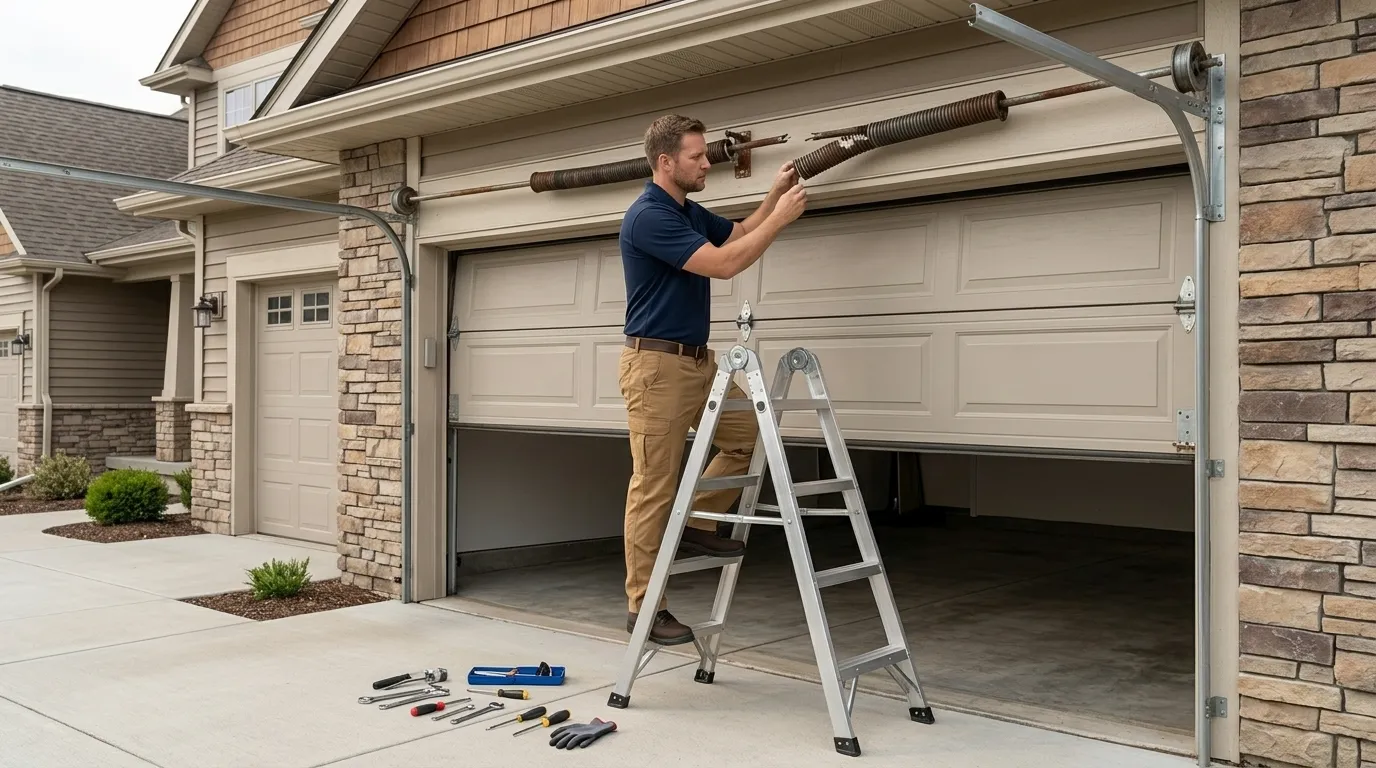
A torsion spring under load can put someone in the hospital, and that doesn't change based on the door's age. What does change with a newer door is the temptation to DIY an opener reset or a sensor realignment, since it looks like a plug-and-play fix. Sometimes it is. If the door won't close and the opener light is blinking, that's often a misaligned photo-eye sensor and a homeowner can usually clear it by checking that both eyes are level and unobstructed. If the door won't move at all, or moves and then reverses hard, that's a spring or cable problem and it's not a DIY repair - not because it's hard to understand, but because the failure mode is violent.
On a 2004-built door, the most common emergency call we get is a door that opens partway and stops, or reverses on its own. That's usually the opener's safety system reacting to a spring that's lost tension, not a bad motor. A door that won't budge at all and feels heavy when you try to lift it by hand is almost always the spring itself, and on a torsion setup that's a job for a call, not a Saturday project. A door that opens fine but the opener light won't stop blinking is almost always a sensor, and that's the one symptom worth checking yourself before you call anyone.
Most Commerce City houses went up around 2004, decades newer than the 1958-2010 stock (median 1982) closer to Broomfield. Newer doors run torsion springs and sensor-heavy openers almost exclusively, so failures tend to be sudden spring snaps or electronic faults rather than the slow sagging failures common on older extension-spring setups.
We're based in Broomfield, about 14 miles away, and we don't have a truck stationed in Commerce City. We schedule the visit as soon as we can and tell you honestly what to expect on arrival time rather than quote a number we can't guarantee.
With a median household income of $106,756 in this area, replacing a full section on a door that's still under 25 years old is often the better call than patching a panel repeatedly. A snapped spring alone is almost always worth repairing rather than replacing the door.
We carry standard torsion springs, cables, rollers, and photo-eye sensors that cover most 2000s-era doors. Some builder-installed opener boards use less common models, and those can mean a short wait on a part - we'll tell you on site if that's the situation.
Call now or request a free quote - same-day service on most repairs, upfront written pricing.