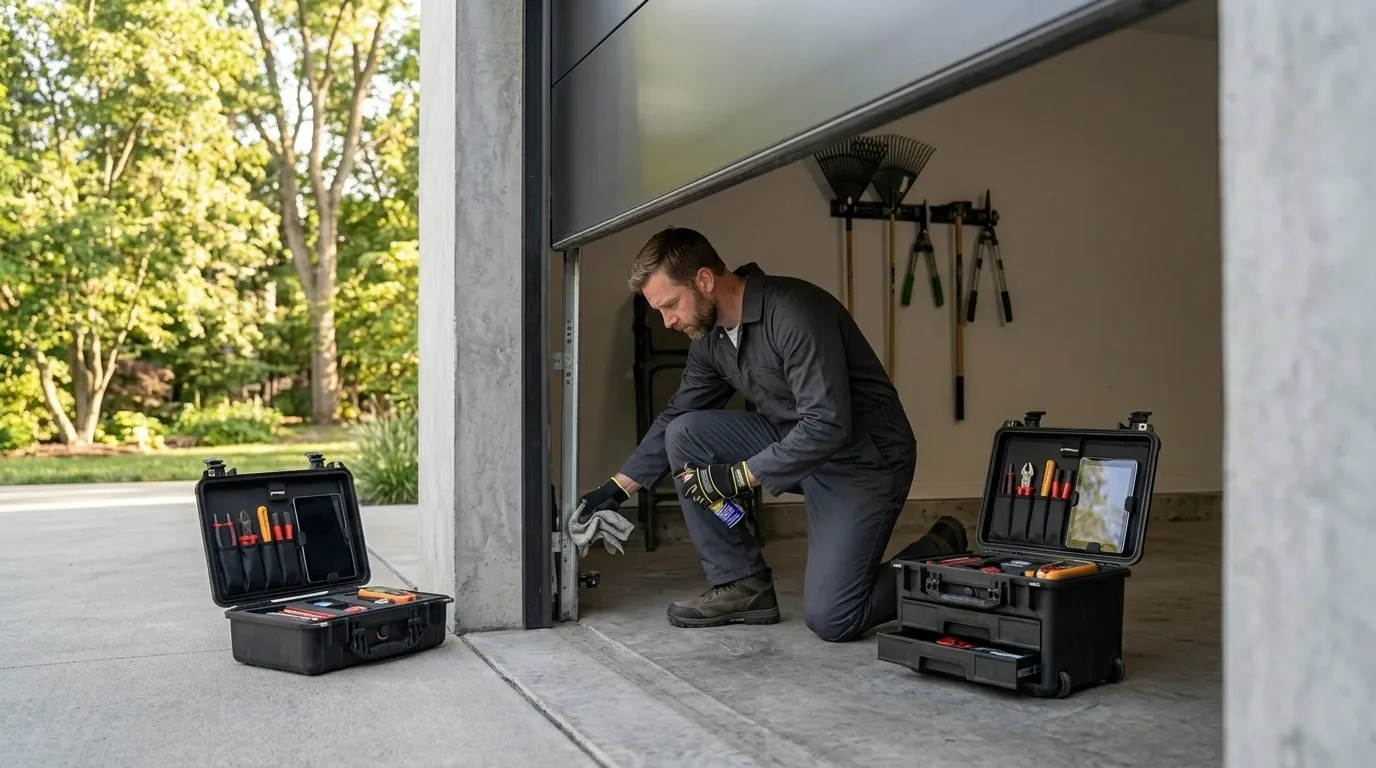
Broomfield, CO · Garage Door Service
Cable repair for Erie's newer garage doors, serviced from Broomfield. Cold-climate wear on 2000s-era lift cables, what it costs, and what to expect.
Most of the trucks working this corridor carry lift cable sized for the doors that actually went up in Erie, which skew newer than the rest of the territory. With a median build year of 2007 here, you're mostly looking at factory-set galvanized cables paired with lighter aluminum-reinforced sectional doors, not the heavier wood-look steel slabs that dominate the 1958-2010 housing stock across the wider service area (median 1982). That matters when a cable snaps, because the drum size, cable gauge, and termination hardware on a 2005-2010 door aren't interchangeable with what a 1985 door takes.
What doesn't always sit on the truck is anything custom - odd-length cable runs on non-standard door heights, or cable for a door that's been re-tracked or modified since it was installed. If your door falls into that category, expect a call back for the part rather than a same-visit fix. That's the one honest limit here: stocked parts cover the common cases, not every case.
A snapped cable on a standard double door with common hardware is usually a same-visit repair once the truck is on site - the cable itself takes longer to source than to swap. The variable in Erie is the six-mile run from Broomfield. That's not a long drive, but it means this isn't a walk-in-and-fix-it operation; it's a scheduled call from a base outside town, same as most of the suburbs this business covers.
If the door is one of the newer builds with an unusual track or a door that's been modified from its original spec, the wait shifts to parts, not travel. A cable that matches a factory 2007-era door is a stock item. A cable for a door someone re-hung or resized isn't, and that adds a day or two while the right length gets sourced.
Because this town is served from Broomfield rather than from a local branch, booking works the same way it does for the rest of the six-to-nineteen-mile ring around the shop - Lafayette, Louisville, Superior, and the rest. You call, describe what the door is doing (won't move, hangs at an angle, one side dropped), and the visit gets scheduled from there.
A cable that's frayed but not yet snapped is worth calling in before it fails completely - a partially broken cable under tension can let a door drop unevenly, which is more dangerous and often more expensive to fix than catching it early. If the door already dropped on one side and won't budge, say so when you call; that changes what gets loaded on the truck before it leaves Broomfield.
The giveaway on a cable problem is usually a door that hangs crooked - one corner low, one high - or a door that won't lift at all because the cable came off the drum. On the newer stock common in Erie, that failure often starts at the drum end, where the cable takes the most flex cycles, rather than at the bottom bracket.
This whole corridor sits in a cold, severe climate band, and cold is hard on cable in a specific way: the strands stiffen, any nick in the galvanizing corrodes faster once moisture gets in, and a cable that's been fraying quietly all summer tends to let go on the first hard cold snap of the season. If you hear a snap or a loud clunk from the garage on a cold morning, that's often exactly what happened.
Don't do this one yourself. A garage door cable is under real tension from the spring system, and a cable that's about to fail can whip when it lets go. That's true everywhere, but it's worth saying plainly here: a newer door with lighter cable and hardware isn't safer to work on than an older, heavier one - it just fails differently.
What you can safely do is look. If a cable is visibly frayed, kinked, or has a broken strand poking out, or if the door sits crooked in the opening, that's your cue to call before it snaps rather than after. Trying to re-wind a slipped cable back onto the drum yourself, with the spring still loaded, is where people get hurt.
There's no published flat rate here worth quoting, since the actual cost depends on door size, whether one cable or a pair needs replacing, and whether the drum or bottom bracket also took damage when the cable let go. What's fair to say is that the newer, lighter-duty hardware common on Erie's 2000s-built doors is generally the less expensive side of a cable job compared with heavier older doors elsewhere in the territory - fewer specialty parts, more common cable gauges.
Household income in Erie runs well above the wider service area average, and in practice that shows up less in what people pay for the repair itself and more in what they choose to do with it: a full cable-and-hardware refresh rather than a single-cable patch, when the tech gives them the choice.
Age of the house isn't the same as age of the cable's exposure. Cold-cycle stress, drum-end flex, and a nicked galvanized coating can fray a cable well before the door itself feels old. It's a wear pattern, not a construction defect.
No. This is served from Broomfield, about six miles out. There's no local depot here - a truck comes from the shop for each scheduled call, same as it does for the other towns in this ring.
On most double doors, yes, if only one cable is damaged and the other shows no fraying. Some techs will recommend replacing both anyway since they're usually the same age and wear together, but it's your call, not a required rule.
Not always, but it's one of the most common causes, especially when one corner sits low. It can also be a broken spring or a bent track. Whoever comes out should check all three before touching anything.
Call now or request a free quote - same-day service on most repairs, upfront written pricing.